
A crime wave that has targeted Australian retailers and resulted in workers being threatened with guns and machetes has prompted the industry and police to join forces in an information-sharing partnership that takes its inspiration from across the ditch.
The partnership, which includes Woolworths and Westfield owner Scentre Group, will create new measures to tackle the unprecedented levels of violence faced by retail workers, as part of a broader push by businesses to lobby state governments for tougher retail crime legislation such as universal workplace protection orders.
In response to the privacy commissioner finding Bunnings breached the Privacy Act in its use of facial recognition, the hardware store released CCTV of the violence against its staff that prompted the use of the technology.
Theft at retail locations rose to a 21-year high last year with police recording about 267,750 instances, according to government figures.
Auror, a software firm that monitors retail crime that may not be reported to police, recorded 800,000 incidents across Australia in the past year with about one-third of those in Victoria.
“These incidents can be terrifying for our people and retail staff, some as young as 16 to 18 years of age, who are confronted with it,” said Scentre Group chief executive and Shopping Centre Council of Australia chairman Elliott Rusanow.
“More frequently this crime is being attached to other serious and violent offending. This can be associated with knives and other dangerous weapons and also organised crime for issues like illicit tobacco,” he added.
Scentre Group led a similar partnership in New Zealand two years ago when its biggest city, Auckland, was hit by rising levels of retail crime, particularly from ram raids where a heavy vehicle is driven into a shop to allow criminals to gain entry and steal goods.
The partnership contributed to ram-raid incidents decreasing by 34 per cent in 2023 year-on-year, according to NZ Police figures.
While existing security partnerships between retailers are already in place, the new alliance will take their co-ordination to a higher level.
It will bring together the chief executives of roughly 20 of the nation’s largest retail-focused companies with senior police officials.
The partnership met for the first time at the end of last year, with senior members of the NSW and Victoria Police in attendance.
Ambushed at gunpoint
Jevan Bouzo, chief executive of Viva Energy’s convenience retail businesses, said the partnership was a necessity because “criminals were moving faster than the police”.
He recounted terrifying incidents where service station staff, who have the discretion to lock doors at night, had been ambushed and held at gunpoint or knifepoint.
“All of a sudden, that person’s held at knifepoint or gunpoint in some cases, tied with zip ties, while the people go in and basically clean out the cigarettes,” Bouzo said.
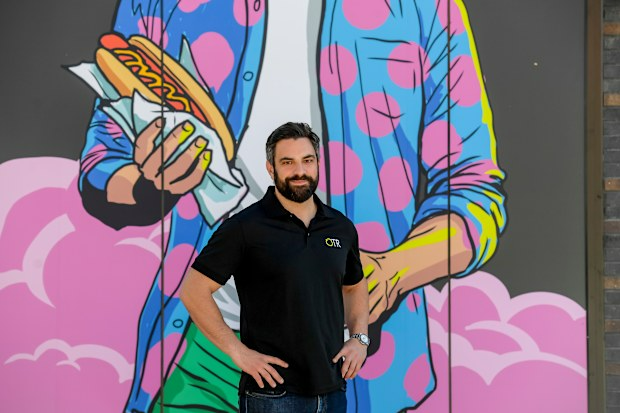
Viva Energy’s convenience retail CEO Jevan Bouzo recounted terrifying incidents where service station staff have been ambushed at gunpoint.
Roy VanDerVegt
“There are organised groups that have a plan to rob multiple stores in a night.
They often use stolen vehicles. These sorts of crimes are planned.
They have face coverings.
They have weapons, in some cases, guns, or knives and machetes.”
During the first three months of 2025, Viva Energy, which runs more than 800 service stations and fast-food drive-through locations, was hit by 40 robberies that used force or a weapon, 26 break-and-enters, and 1591 threatening situations.
While the partnership will focus on operational solutions, retailers are also lobbying state government ministers for tougher action.
At the top of their wishlist is the introduction of workplace protection orders across every state and territory, which would legally bar known offenders from entering stores.
Executives from the Australian Retailers Association, Woolworths and Endeavour Group, which owns the liquor store chains Dan Murphy’s and BWS, have met with Queensland Police Minister Daniel Purdie to advocate for these measures.
Retailers are also calling for dedicated police retail crime task forces, citing that only South Australia has one in force.
Currently, the ACT is the only jurisdiction with such laws in place, while South Australia and Western Australia are introducing similar legislation.
Woolworths, a leading advocate of protection orders, has pointed to their success in sharply reducing incidents in the ACT and wants them to be implemented nationwide.
The supermarket giant’s staff have been at the sharp end of the violence, and Woolworths had to lock down stores on 45 occasions in the first half of this year due to security incidents, often with customers still inside.
But despite the push by Australia’s biggest retailers, a nationwide legislative solution remains elusive.
In Victoria, Premier Jacinta Allan has vowed to introduce tougher penalties for retail crime and has not ruled out introducing workplace protection orders.
The NSW and Queensland governments are also considering the measure but have no immediate plans for any bill to be introduced.
In response to the rising violence, Woolworths, Coles and Bunnings have begun equipping frontline staff with body cameras and training thousands of others in de-escalation tactics.
View article source here.
Subscribe to our free mailing list and always be the first to receive the latest news and updates.